


PAS Time Attack Program
3/1/2010
PAS Time Attack Program
Working title: Chassis set-up, so what now?
By: Jeff Cheechov
So your team has made a huge investment of time and cash; you have schemed and planned and poured over the rules and schedules. You have planned and executed a dream project: Build and campaign a Time Attack race car.
Of course you have assembled the best components, powertrain, brakes, safety gear, lightweight carbon body panels and some trick aero mods. You now have a real racing suspension with coil-over dampers, a small trainload of springs, numerous spherical bushings, big hefty sta-bars, the lightest wheels on the planet, super-sticky tires and a few too-trick-to-talk-about special goodies "just in case" you need to shave off those last few tenths of a second off your lap times.
All those components are great, but now you need to get them working together, in concert with one another. This is where tuning becomes an art. You know how important it is to spend the time (and money) tuning your engine combination on a chassis or engine dyno. So, take the same idea, and apply it to tuning your suspension as well.
As with engine preparation, some chassis set-up work can be done in the shop, like checking all suspension mountings for wear and correct torques, setting wheel alignment and corner weights. At some point, you will need to address the dynamic phases of chassis set-up, on the track during test and practice sessions.
The major chassis tuning considerations for discussion here are driver and course selection, communication and data collection, tire temperatures & air pressures. We need to make carefully-selected damper-spring-alignment-air pressure changes to develop and tune a faster and more predictable Time Attack car.
Driver selection and communication:
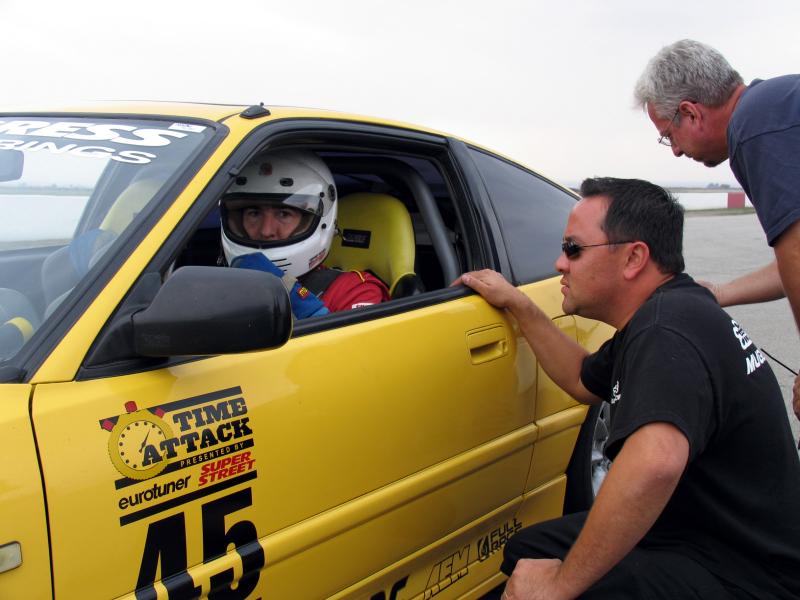
Sign up an experienced and consistent driver that knows the course. Training new drivers and learning a new course is not the time for fine tuning your suspension! Consistent lap times and good communication with your driver will really pay off here. A good test driver must have a consistent racing line, be able to communicate with the crew, and relay accurate information. Oh, and he always buys dinner too.
Alignment and corner weighting:
Determine a good general set of alignment and corner weight specifications as a starting point, before loading the car in the trailer! Document these settings on your set-up sheet, and note your initial damper-spring-bar settings as well. Make notes as to what you have changed during testing! Corner weighting is essential before leaving the shop. As a starting point for a road racing or slalom situation, we start with 50% cross-weight, where the sum of the diagonals are equal. With this "square" set-up, the car will balance similarly in L&R hand corners. This is achieved by adjusting the spring perches up or down, with the driver onboard (or similar mass), and the sta-bars disconnected. Check air pressure and alignment settings beforehand! Record the corner weights and all-up-weight (AUW).
Tire temperatures & pressures:
Set and record the cold tire pressures before going out. You can consult with your trackside tire engineer (or your last set-up sheet) for cold settings beforehand. You will need a simple tire pyrometer, (not an infra-red pyrometer!), tire pressure gauge, your set-up sheet and a pencil. One key to collecting effective information is to "poke" (test) the tires immediately after the car stops in the pits from a hot lap. Pit boxes closer to the last turn are preferred. Record the temps in three locations (inside-middle-outside) consistently, and check and record pressures. Start at the hottest front (outside corner) tire.
Heat is developed by doing work (grip). The warmer tire temps are doing more work. Your job is to tune the alignment and pressure settings to balance the work. The more even the tire temps are, the better balanced the chassis is. Wheel spin and gross chassis imbalance also shows up here, as higher temperatures and excessive pressures caused by heat buildup.
Making changes:
Make small changes until you really understand how each change affects the handling! Make one change at a time. Take only a few (consistent) hot laps to evaluate the change. Record every change and result. Is the handling issue better or worse?
Chassis tuning is an art and a science. Both driver and crew should read and study the material available, and offer to help out and "go testing" whenever the opportunity is available. Learning effective trackside tuning is an essential skill-set for any successful Time Attack team.


